Have you ever wondered how to render bacon fat to create your own natural dripping? If so, keep reading, as we have all the various types of animal fats,and their best uses, covered…
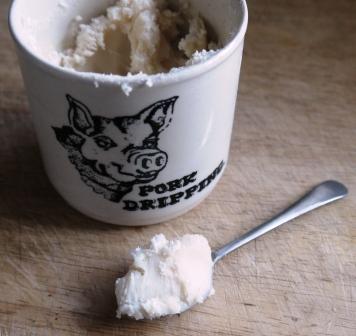
In the days of my Grandmother, dripping suet and lard were useful by-products of rearing and butchering meat, and would have been used on a daily basis. These fats were used in cooking, medicine, candle & soap making, seasoning cast iron pans and even shining shoes!
However, in the so called ‘health conscious’ years of the 80’s, these natural fats were demonised to the point that people think you’re mad if you admit to spreading a piece of hot toast with dripping.
Have you ever tried it?
When you realise that bacon lard in particular contains less saturated fat, cholesterol & sodium than salted butter, perhaps you won’t be so repulsed. As with most (naturally produced) foods, eating it in moderation won’t kill you (can you say the same for the trans fats, found in margarine up until the 1990’s?) but will however add an amazing flavour to so much of your cooking.
To put it simply, when you render bacon fat, you heat a solid lump of fat until it melts. You are left with a liquid (the bit we are after) and crispt pork scratchings. The latter be sprinkled with a little salt and happily (and healthily!) consumed on a keto dite. Or they can be to the hens, cat or dog as a treat and only in small quantities.
How to Render Bacon Fat
To make your own Bacon lard, all you need to do is heat the fat until the liquid fat separates from the solid. You can do that in the oven or on the hob, whichever is easier for you. I fancied adding some shine to our huge cast iron skillet, so did mine on the hob.
To extract as much oil as possible, chop up bacon fat into small pieces, pop in a pan and heat over a medium hot heat. You don’t want it to burn or splatter you too much, so turn the heat down if it’s getting fierce.
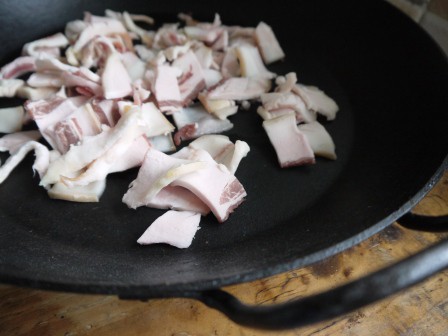
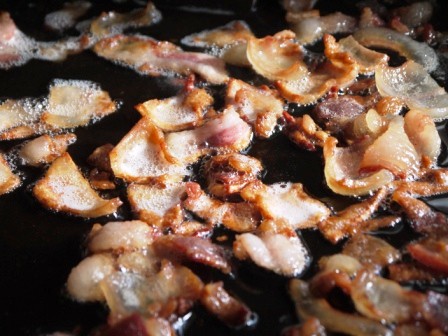
When it is swimming in oil and the scratchings look crispy and lightly browned, pour the oil off into a jam jar or pot. Once cool it can be stashed in the fridge. It doesn’t really matter if there are little crispy specks of bacon in it, as the fridge & the fat will preserve it well enough. However, you can strain it through a coffee filter or muslin if you want it perfectly clear.
Top your pot up every time you fry a few rashers of bacon, it doesn’t really matter if you’ve fried your eggs and sausage or two in the same pan as the bacon, just tip the grease all in.
If you keep pigs, you’ll tend to work with huge batches of fat. You’ll probably find that using the oven is easier and creates a cleaner lard than the frying pan. Pour off into tubs, cool, label and pop in the freezer where it will keep indefinitely.
Once you build up a little stash of this glorious fat, try roasting potatoes till crisp and super tasty. Leek & onion pan fried in it tastes glorious, as does popcorn. Or replace the butter in bread, scones or pastry with it.
Or you could spread it on hot fresh toast, just like Granny.
Let me leave you with this interesting fatty snippet from The Independent site.
On the menu? Know your fats
Butter: Mainly saturated fat, which should be refrigerated and well wrapped to protect it from light and absorbing strong smells. Humans have been eating butter for more than 10,000 years.
Lard: Real lard is hard to find, so terrified are we of the creamy rendered pig fat. Foods fried in lard become very crisp and absorb less fat than foods cooked in oil, and it makes great flaky dough.
Dripping: This is the fat that drips from meat while it cooks. Beef dripping is the most popular. Brown beef or lamb in their own dripping and the flavour will intensify.
Suet: This fat surrounds an animal’s kidneys and is rarely found any more. It is a hard fat with a high melting point so great for deep-frying and making pastry. Grate it into your mincemeat and dumpling mixes.
Tallow: A general term for fat rendered from cows or sheep, best known as an ingredient for candles and soap. Save some for your roast potatoes and Yorkshire puddings.
The Earth Beneath My Feet says
Oh my word Janie, that takes me back to my childhood all over again. My Mom used lard for many things and suet for meat pudding steamed in cloth. I remember everyone fighting for the dripping from the Sunday roast and spreading it on bread for a teatime treat. Such nostalgia! :-)
HedgeComber says
When did you/your family stop using it, and can you remember what else she used it for?
Janie x
Midas says
Memories.Monday Washday.cold meat but there was always plenty of bread n drippin for Monday’s break fast n “SNAP” ie sandwich to take to the pit/ mine.We didn’t have Cornish Pasties.lol.
Stacy says
Can you use lard for baking? And how would you do that?
HedgeComber says
Absolutely Stacy! In short crust pastry use half lard & half butter – this will give you a lovely, tasty crisp pastry. I made bread yesterday adn replaced the tablespoon of olive oil I usually use with the same of lard to see how that would work – it is fine! No change to taste or texture of the loaf, and yet it is a free oil! I’ll have a think about other uses for it too, and may have to turn it into another post!
Janie x
Liz @ Quirky Vistas says
Love this post! My mom is 95 and has always saved her bacon drippings for cooking. Lard and suet were ingredients I heard my mom mention and saw her use all during the time I was growing up. I’m glad to see this reminder and I’m going to give it a whirl! Thanks so much for stopping over at Quirky Vistas and taking the time to leave me a comment.
Liz
HedgeComber says
Likewise! Lovely meeting you Liz and I’m following you on Bloglovin’ now :)
Janie x
Cheryl says
Lovely! We raised mangalica pigs for two years when we first moved onto our little farm in Hungary and I just loved taking care of them, loved eating them too :) Happy bacon eating!
HedgeComber says
They are lovely creatures, we’ll be getting more in the spring :)
Heather says
Awesome information! Thanks for sharing! We have been considering getting a pig, and figuring out how to use all of the animal is important to us.
HedgeComber says
Brilliant news Heather, waste not want not! :)
Anne Simpson (@auth_simplicity) says
I love frying with bacon grease! I always save mine.
HedgeComber says
Hey Anne, thanks for popping by!
Janie x
Sarah Yoder says
Hi, found you through the Homestead Barn hop. Great post and good timing for me! I’ve recently been reading up on the unhealthy use of vegetable oils for cooking and how we’ve all been “brainwashed” into thinking this is the healthier option and how we should be moving away from this and going back to the “old-fashioned” (and actually much healthier) way of using lards and drippings for cooking. So I’m so glad I found your post because I’ve been wanting to do this but wasn’t quite sure how to begin! And plus I love bacon drippings and am sure this will add a great flavor to the other foods I cook!
HedgeComber says
Hey Sarah, great to hear from you! Isn’t it sad how society is swayed by ‘experts’ so readily?
I’m beginning to think if Granny did it, I’ll do it. Forget all the latest health advice & labels, just trust that if it was good enough for our ancestors, it’s good enough for me :)
Janie x
Michael Kovaleski says
I thought everyone did this, anyways, local pork fed a clean and healthy diet is always best. Yay bacon.
HedgeComber says
Yay bacon indeed! Sadly a lot of people have been scared off using natural fats altogether Michael, believing processed fats are better & healthier for them.
Janie x
Girl Going Country says
LOVE LOVE LOVE keeping bacon fat in my fridge to cook with! Growing up, my mom used to make us asian noodles with bacon fat and a little salt. Now I put some on rice and fry and egg (in bacon fat, of course) to throw on top for a quick lunch.
I do have one question – I’m sort of paranoid about how long food can keep without spoiling. How long will bacon fat be good if kept in the fridge? I usually use up my batches with a couple weeks – but there have been times that I have more bacon fat than I can use up in that amount of time (when balancing with cooking with butter and coconut oil).
Your insights are greatly appreciated!
HedgeComber says
Hi GGC! I wouldn’t expect any fat to go rancid if stored in the fridge, so I would be happy storing it for months.
However, if you have excess and you’re not sure, why not pop it in a separate container and freeze it? It’ll never spoil in there!
Janie
Evelyn @ My Turn (for us) says
Bacon fat! Oh yes, I grew up with it (in fact my Mother had a container that was part of a set that she used that was labeled “grease”) My Dad even loved hot bacon fat dripped over a salad.
I use it for white gravy and I guess I am telling my age because I still use cast iron skillets seasoned with bacon fat!
Thank you for sharing at Freedom Fridays!
HedgeComber says
Hi Evelyn, thanks for popping over, and thanks for hosting such a lovely hop!
Is white gravy the same as white sauce in the UK do you s’pose? Milk, butter & flour? The white bit in a lasagne? I’m intrigued :)
Janie x
aushapasha says
I’m rendering 2 lbs of bacon in the hopes of collecting enough to use in a recipe. My grandmother used to add a half cup of water to the pan of bacon and cover with a lid…I’m using her method but I do have a question: when I put the collected fat in my jar and let it set up in the fridge, the water will separate from the fat, right?? I’d call gma, but she’s no longer with us…any ideas??
Jane Sarchet says
I have no idea! I guess any water will separate, but do you remember her leaving the lid off towards the end for the water to evaporate?
I’m not sure why you’d need to add the water, if you ever work it out please let me know.
Janie x
Tonia Addison-Hall says
I never refrigerate my butter dish, who would do such a thing??
Jane Sarchet says
:)
Janie x
Patrick Lindsey says
I am saving mine for making soap. It is supposed to make a great bar.
Jane Sarchet says
Fantastic! Do let me know how you get on with soap making :)
Janie x
april says
Pork dripping on a slice of fresh bread with a sprinkling of salt was a regular meal for me and my brothers back in the 1950’s, in Yorkshire. “mucky dripping” can still be bought in the local markets. If you cook a joint of pork and pour off the juice and fat into a clear glass bowl it settles into two layers. The very condensed meat juices set to a jelly at the bottom and the dripping in a layer on top. When cold, the two were mixed roughly together with a fork, giving dripping with “mucky” (or brown bits”) in it. Wonderful taste.
And now I must go and put joint of pork in the oven ! LOL Guess what I fancy for my tea.
Jane Sarchet says
Oh my, I may actually be drooling April! I love that htye were called Mucky Drippings too, hilarious :)
Thanks for taking the time to visit and leave a comment, and have a wonderful 2016
Janie x
april says
Thanks Jane and the best to you and yours for 2016. When i was little, even in cities we raised our own pork , chickens and rabbits. Not now though due to city laws ! I have a bit to add about “mucky dripping” Instead of using butter on bread for a cold pork sandwich, use mucky dripping ! superb ! I am sure you have heard the saying that you can eat everything from a pig but the “squeel” Just so. Lovely website ,thank you.
audrey says
every year on 4th of July we rent a camp for a week. I cook at least 3# of bacon per day. I save all the bacon grease and use it all year.
Jane Sarchet says
Oh wow Audrey, I bet that makes a LOT!
Thanks so much for stopping by & taking the time to leave a message :)
Jane x
Caroline Kutz says
I have a dumb question…can you use rendered bacon fat for pie crust making? :) Carol
Jane Sarchet says
Not dumb, and YES! A very tasty pie crust you would have too :)
Jane x