Now’s a good time to run through the basics of food hygiene to ensure that you know how to safely cook turkey & keep everyone healthy this Christmas.
Nail the turkey, and you’ve nailed the whole dinner!
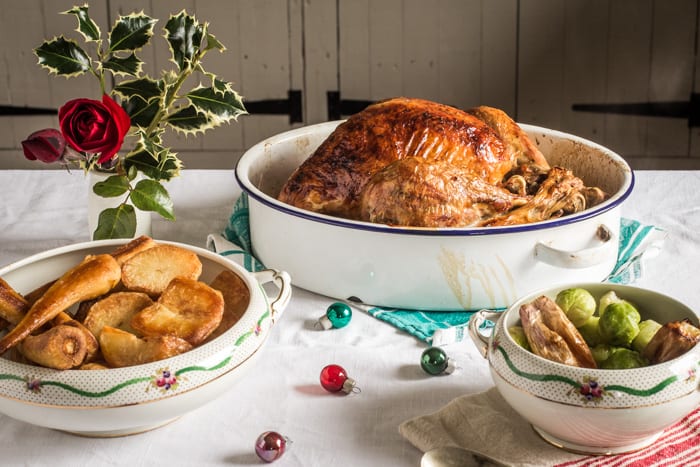
Lining up all the elements of a Christmas dinner can be intimidating enough.
But ensuring it’s done safely, so no one gets food poisoning, is imperative.
This article on how to safely cook a turkey isn’t meant to scare you, just give you the basic food hygiene tips that will see you and your family happy and healthy long into the New Year!
How to Safely Defrost Turkey
Did you know that an average Christmas turkey takes a full 2 days to defrost?
With all the other yummy food that needs fridge space, that can drive some people to defrost them in the bathtub, garage or even the garden shed!
In an ideal world, your turkey will defrost in the bottom of the fridge.
Keep it inside its wrapper, and place it in a large baking dish that is deep enough to contain any juices that leak out of the packaging.
Failing that, defrost it somewhere cool, where no animals or vermin can reach it.
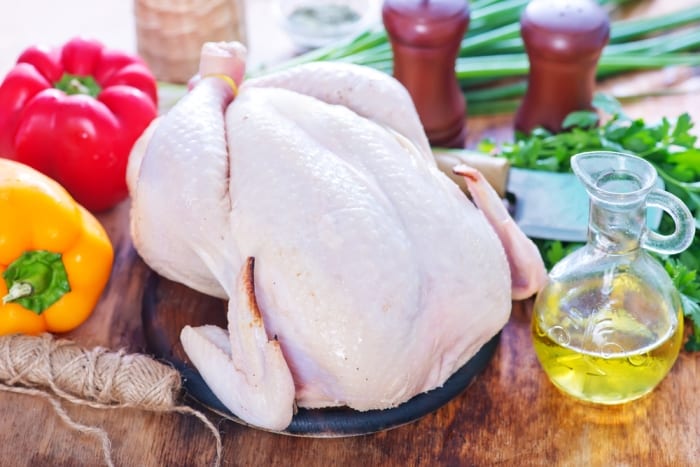
Image credit: Shutterstock
How to Safely Store a Raw Turkey
Whether you’re buying fresh, or have just defrosted your turkey, it must now be kept in the bottom of the fridge (or somewhere just as cold). Also, ensure hands are washed in warm soapy water after touching the packaging or meat itself.
When you take it out of the packaging, do not wash it.
Washing splashes raw juice (and therefore bacteria) around the kitchen which can easily contaminate other food, utensils or hands.
The bacteria we’re worried about is all killed by cooking so there’s really no need to wash it first.
How to Safely Cook Turkey
To work out how long to cook your turkey for first, you need to weigh it.
For every kilo of meat, you need to allow 45 minutes in the oven, with an extra 20 minutes added on.
Also factor in resting time (this will make the meat more tender, juicier and easier to carve so please don’t skip it!) of 30-60 minutes.
So, for a 7kg turkey it would be:
7(kg) x 45(mins) = 315(mins)
+ 20(mins) = 335
+ 30(mins) = 365(mins), or at least 6 hours and 5 minutes.
When it comes to cooking a turkey, remember that it is essential it is cooked through properly.
There are lots of ways of telling if it’s cooked (such as piercing the flesh at the thickest past and seeing if the juice runs clear. Or if the leg falls away from the body when gently pulled).
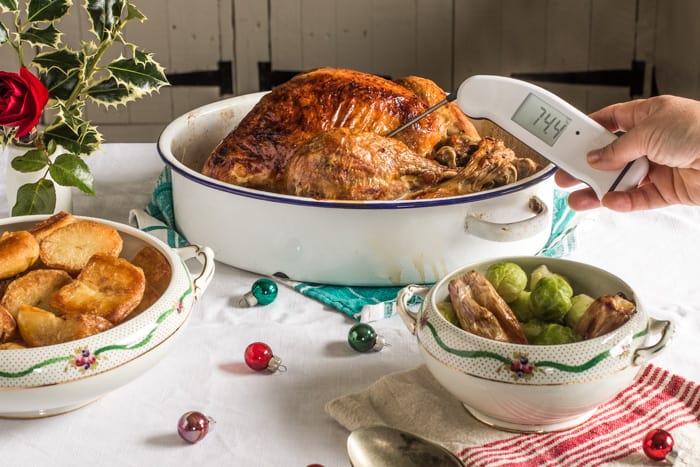
However, the only way to absolutely, without doubt know that the turkey is safe to eat, is by ensuring the internal temperature reaches and/or exceeds 74°C (165°F).
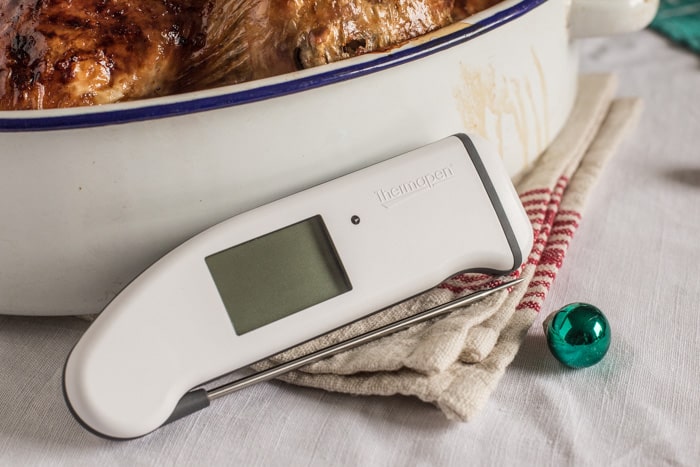
Invest in a digital thermometer (I have a white one from Thermapen, but they have lots of fun colours and patterns to choose from) and you’ll never be left wondering if the roast is ready to serve again.
This is even more important if you are cooking for a child, pregnant or elderly person, as food poisoning can be fatal.
Push the tip of the thermometer into the thickest part of the meat, between the breast and thigh.
Stop just before you touch the bone and hold still for just 3 seconds.
Thermapens are so highly sensitive that you’ll see the temperature dance around a little as the meat continues cooking after being removed from the oven.
It’s also worth noting that if you’ve hit that temperature, it’s OK if there’s still some pinkness in the meat close to the bone.
According to the FAQ page on the Thermapen site: “the bone marrow in chicken (and turkey) bones can release blood when cooking.”
How to Safely Serve Turkey
Thankfully, this is the easiest stage of Christmas dinner to control!
Whilst the turkey is in the oven, clean the kitchen and wipe all surfaces down with hot soapy water.
This will eliminate any chance of cross contamination and make clear up after the big meal so much easier!
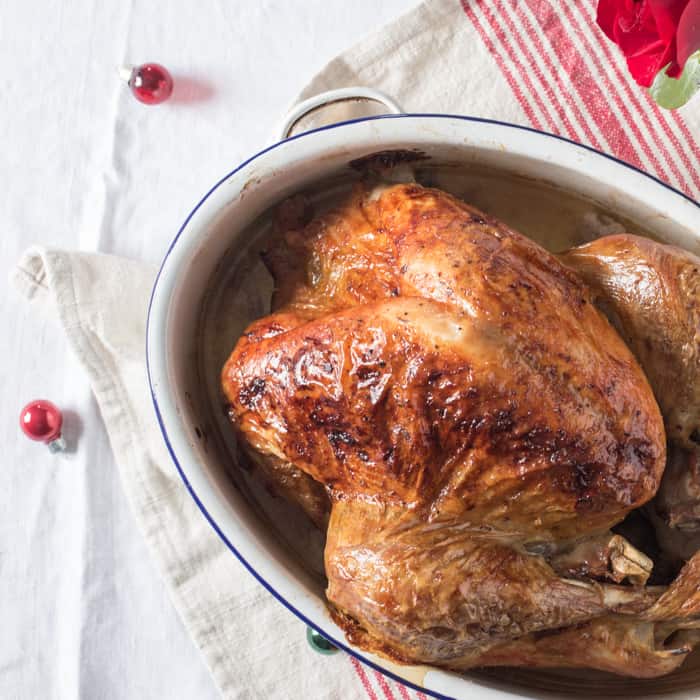
How to Safely Store Turkey Leftovers
Once the meat is carved, the rest of the turkey needs to be cooled down as quickly as possible before being chilled properly in the fridge.
I always aim to carve the rest of the meat off the bone soon after my dinner.
A tub of cooked turkey goes into the fridge for sandwiches.
And the rest goes straight into the freezer.
Never put hot, or even warm meat directly into the fridge or freezer.
Always cool it to room temperature first, then preferably chill in the fridge before popping into the freezer.
Skipping the fridge stage won’t cause you any problems if you are short of time/fridge space.
To freeze, I lay the slices of turkey out on a piece of baking paper on a tray, and freeze the whole tray.
When frozen I tip the slices into a freezer bag.
You’ll then be able to take out just as much turkey as you need for any future meals without having to defrost the whole bag.
This is known as ‘dry freezing’ and is really useful when freezing berries in the summer months too.
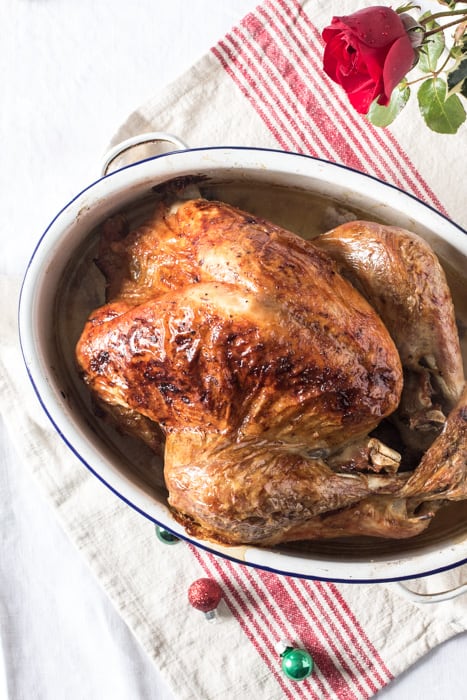
I hope this article on how to safely cook turkey helped you understand how to work safely with raw poultry.
All the above tips are good basic kitchen hygiene and aren’t just for Christmas!
How to safely cook Turkey
- 1 whole turkey removed from the fridge an hour before to bring up to room temperature.
- Butter softened
- Preheat the oven to its maximum setting (don't worry, you're going to drop this as soon as the bird goes in!)
- Check the cavity both ends for a pack of giblets, and remove if you find any.
- Weigh the bird, and work out the timings. Calculate 45 minutes of cooking time per kg, plus 20 minutes extra, plus 30 minutes of resting time.
- Slip your hand in the back end of the turkey, between the skin and the meat. With your palm down, gently work your way around the breast of the bird loosening the skin.
- Take a large knob of softened butter underneath the skin and spread it evenly over the breast meat. Repeat until it is well coated and wipe a little more butter over the skin.
- Feel free to stuff your bird at this point, although we cook our stuffing separately. Take a large sheet of tin foil and tent it over the bird, tucking in tightly.
- Pop the bird into the preheated oven and drop that temperature to 180C/350F/gas 4
- Every 30 or 40 minutes scoop the juices from around the pan over the bird to baste it. This will stop it drying out. 3/4 of the way through its cooking time, remove the tin foil to allow the skin to brown. Keep the sheet of foil as when you remove the roast, and have ensured it's safely cooked through, you need to cover it back up with the foil. Top the foil with a clean hand towel and let it rest for at least 30 minutes before carving.
Huge thanks to Thermapen for sponsoring this content, allowing me to keep bringing you tasty content, for free. As always all thoughts (and leftovers!) are my own.
Janie x
Sources: British Turkey, Food Standards Agency, NHS Live Well. 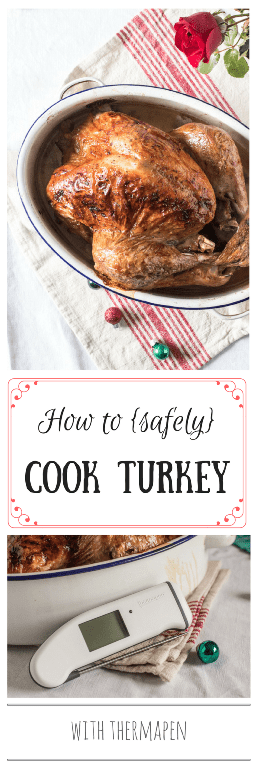
Katie Bryson (@cookingkt) says
What a fantastically useful guide Janie – love it. Defrosting turkey always takes at least twice as long as you allow for doesn’t it! I’ve gone for Turkey Parcels this year as we’re a mixture of veggies and meat eaters, so hopefully this should make things a bit quicker. I love your dry freezing tip… such a great idea!!! I do it with fruit all the time, but never thought to do it with meat – genius!
Jane Sarchet says
Thanks for your sweet message Katie! The turkey parcels sound like a great idea, here’s a to a fabulously tasty Christmas!
Janie x
certifiedpastryaficionado says
I loooove my meat thermometer. I cannot cook my turkey properly without it! Thanks for all the other tips! They are so helpful, especially for those cooking a turkey for the first time.
Jane Sarchet says
They are pretty handy that’s for sure!
Janie x
kerrycooks says
Such useful, comprehensive tips Janie! This looks delicious
Jane Sarchet says
Thanks Kerry, I remember my first crimbo dinner & I was terrified of not getting it right!
Janie x
Corina says
We’re not at home for Christmas this year but my husband still would like me to cook a turkey afterwards just for us. I’ll probably have loads of leftovers and I do find some of it goes to waste so I definitely need to follow your tips on how to freeze it in slices afterwards.
Jane Sarchet says
You’ll be grateful for that bag of frozen goodies by about mid February Corina!
Janie x
Platter Talk says
Thanks for the tips and directions. These will be considered and used next time I bake a big bird! : )
Jane Sarchet says
My pleasure :)
Emily says
Some brilliant tips here – thank you! :) I’m luckily at my sister’s this year xx
Jane Sarchet says
Thanks Emily, hope you all have a lovely day :)
Janie x
Garlic + Zest says
Happily, my Mom was in charge of the bird this year — and I’ll be making lamb for Christmas — but these are great tips. No-one wants to end up praying to the porcelain God after dinner!
Jane Sarchet says
Exactly Lisa! Enjoy your lamb ;)
Janie x
shashi at runninsrilankan says
I so love this guide! I need to print it and put it on my fridge because, last yer guess what I did? I baked the turkey with the giblets still inside?! BAHHHHH!!!!!
Jane Sarchet says
Oh no! Was dinner salvageable Shasi??!
Janie x
amir says
hey jane i know this is irrelevant to this post but i just had a question ,, i feed my chikens and ducks with wheat bran and bread sometimes mixed with corn flakes this is the way my grandpa used to feed his poultry i just wanted to know if this is ok .
Any advice would be appreciated .
Jane Sarchet says
Hi Amir :) Poultry will certainly survive on the foods you mentioned, however they possibly won’t be as productive (in terms of number and quality of eggs laid/meat to fat ratio in meat birds). Think of it as a human living on junk food or balanced nutritional diet. That said, whilst prepared rations of chicken feed that contains all the nutrients necessary, it’s not what they’d eat if living in the wild and eating a totally natural diet.
I don’t think there is a right or wrong answer, do what you feel is best for your birds :)
Merry Xmas Amir
Janie x
PS one thing reading back through your post – you might want to bump up the protein levels and make sure they have access to grit & shell for egg production x
amir says
Thanks a lot jane , , so you think i should feed them with chicken food ?? pellets or something ?! i have 8 muscovys 5 turkeys and 10 chickens .. i wanna breed the muscovys next summer you’ve no idea how much i love them :)
Merry xmas btw ;)