Although chickens can’t actually fly, they can certainly flap theirs wings energetically enough to clear a fence and cover a distance of 15 foot or so. A good way to sort this is to follow these 3 Simple Steps to Clipping a Chickens Flight Feathers.
If this likely to become a problem for you (or them) an effective solution is to clip the feathers on one wing which serves to unbalance them, and they quickly lose confidence in even trying. Clipping both wings will defeat the object.
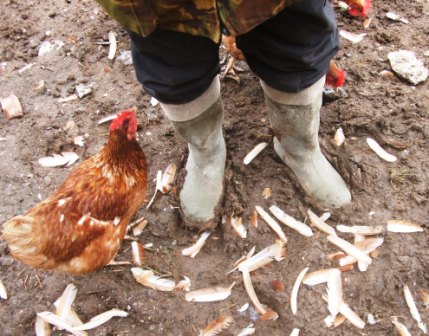
When a chicken moults, she’ll shed each of her flight feathers and grow new ones. When a feather grows, it has a blood supply feeding it which can be seen as a dark, almost black colour within the feather shaft. Avoid cutting through the feather where there is a blood supply, as it will hurt the hen and leave her at risk of infection.
When the shaft of a feather is white and looks hollow, it means the blood supply has receded, it is safe to cut through and the hen won’t feel a thing.
How To Clip a Chicken’s Wing
My hens are all trained to come running to the sound of my voice, so catching them is never a problem. We do however, have a large fishing net hanging in the barn which makes catching new or timid birds much easier.
All you’ll need to clip their wings is a pair of sharp scissors. I’d also advise having another person help you by holding the bird if you haven’t done it before, so you can take your time to understand how the feathers are attached and where is the best place to cut.
Step one; Have your helper hold the chicken sideways, pinning one wing against their chest, leaving you free to get to the other one. If you are clipping an aggressive cockerel, have them hold his head under their arm leaving their hands free to firmly grip his legs. Cockerels have spurs as well as claws and if you have a feisty one, they may well put up a fight.
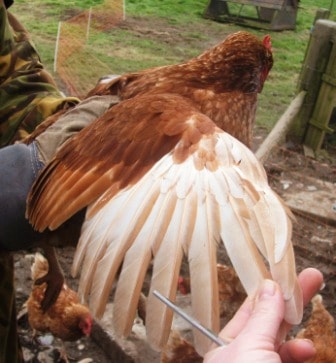
Step two; Gently stretch out the free wing and take a good look at the 10 long, main feathers that make up the wing. Look at the underneath as well, and judge whether the feathers are immature and have a blood supply or are mature and hollow.
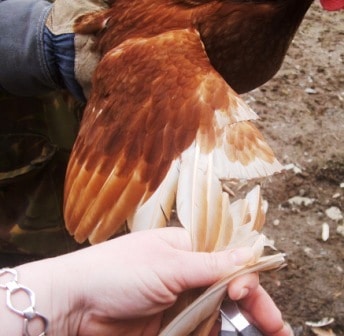
Step three; Using the scissors, snip right down the wing, removing about half of the feather length. Keep checking underneath the wing to make sure you are not going too far in to the bird to avoid cutting her flesh, or too low down the feather shaft.
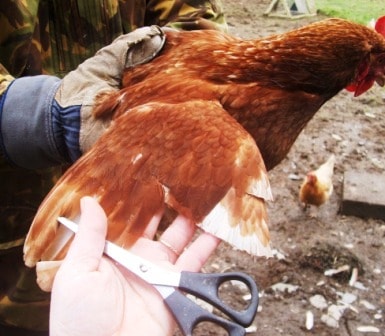
Keep going until all the flight feathers are reduced. It really is that easy!
Trasie Inkersole says
Thats brilliant. Thanks Janie. <3
HedgeComber says
You’re welcome Trasie and thank you for popping by! xx
hencorner says
I clip my girls’ wings, but still have some that jump on top of the Eglu and launch themselves over the fence!
HedgeComber says
Yep, it’s not 100% I think the key is to un-nerve them enough to make them stop trying, sadly if yours have already found a way round it it’s going to be very difficult to break that behaviour now.
Can you make the fence any higher or move the Eglu (ie launch pad!) further away from the fence?
Soulsby Farm - A Very Small Farm says
Great post! I’m going to give it try come spring.
HedgeComber says
Good luck and thanks for stopping by!
Bridget says
Brings me back to the days when we kept chickens. That was before foxy loxy and mr. mink paid us a few visits. I do miss them though!
HedgeComber says
Ooh, you had mink attacks? Not nice. Do you have many in your area? We have lost several birds to the fox and badger, it is so sad :(
Jo says
I’ve got a bit of a problem with one group of hens which are pulling each others feathers out, mainly around the back end. I’ve bought feather pecking spray at £11 a time and am just finishing the second bottle with no noticeable improvement in the hens. They have a big run and several things in it to help keep them occupied. Have you had this trouble and if so, how did you solve it?
Thanks
HedgeComber says
Oh, that’s not good Jo. It’s never happened with my lot, I wonder if it’s because they live in a barn so have tonnes of room to get away from each other and free range over an acre or so?
Are they all doing it, or just one or two? xx
HedgeComber says
Just been reading about hen nutrition, and apparently a red mite infestation can cause feather pecking/cannibalism – any chance they have them?
smallholderwannabe says
I’ve checked the hens for lice etc and the house for red mite and can’t find anything. We’ve had red mite before (yeuccchhhhhhh) and therefore unfortunately know what I’m looking for there. I’ve only had an infestation in the summer half of the year before and this is winter. But I had wondered about that and have checked thoroughly.
There are 7 hens in a run that is supposed to be big enough for 20 hens so I would expect them to have enough room. I’ve spent ages just stood watching them (long enough that they stop watching me in case I’ve brought food and get on with doing what hens do) and I haven’t spotted which one or ones are the main culprit. They ALL have feathers missing. They are laying very well at the moment so as they seem to go off laying at any pretext, I find myself quite baffled.
HedgeComber says
Red mites are horrid aren’t they. What a mystery the feather pecking is, sorry I don’t have any words of wisdom for you either. I’m gonna keep an eye on your blog though, as I’m intrigued what is going to fix the problem. All the best Jo x
Juica says
I will make a watery paste of cayenne pepper and rub it on the back of their necks and other places they like to peck. It usually stops it. I have tried cinnamon oil and peppermint oil too, (just cheap stuff from eBay) and that helps. I can’t afford pecking spray and some of my hens would peck the others until there were no feathers and they were ripping out their skin! I didn’t want to have to kill my aggressive birds if I didn’t have too. Thank goodness these solutions worked. I did eventually cage, (in a small rabbit size cage)the two most aggressive hens for two weeks. After that, they mellowed out. DON’T Remove the hens who are being picked on. When you return them, they take it out on the worse.
Good Luck!
HedgeComber says
Thanks Juica, what great advice!
The Farmers Taft says
I keep reading useful posts about chickens like yours and I know I’m headed for chicken-ville. Now it’s just a matter of time. Tick-tick-tick-BUCKAWW! The very definition of an egg-timer. Thanks for the pictures too!
HedgeComber says
Haha, just give in to it! You won’t regret it :)
Thanks for stopping by, Janie x
Ruchir says
Hi,
I am from India and I have three Aseel hens. I had one for year and recently got two more. The old ones’ feathers are clipped. I did it because I was afraid it would fly away and get killed by street dogs or something.
But after laying eggs and chicks a couple of time, she doesn’t go anywhere.
Is it possible for her to grow then new feathers so she can at least protect itself from cats and other things if she is in danger? how to make the clipped feathers grow back? I dont think she has molted in a year… Please someone guide me.
Jane Sarchet says
Hi Ruchir, I am led to believe that wing feathers grow back during a moult, but have never witnessed it myself.
Perhaps you could let me know for sure next time she moults?
Janie x
sandra says
I clipped mine but not as far back as yours. I have two that get out daily and tear thru my flower beds. Im going to clip deeper tonight. I wonder if the blood flow recedes after the first cut…like a dogs nails seem too. I will flip and pay close attention to that supply. I was scared to cut to far and trimed about 2-2.5 inches off both R and L wings. As I speak they are in my flower bed again,,,,always the same TWO…grrrrr.
Jane Sarchet says
Little buggers :) Let me know how you get on Sandra and if it stops them getting out.
Janie x